
2030 Objective
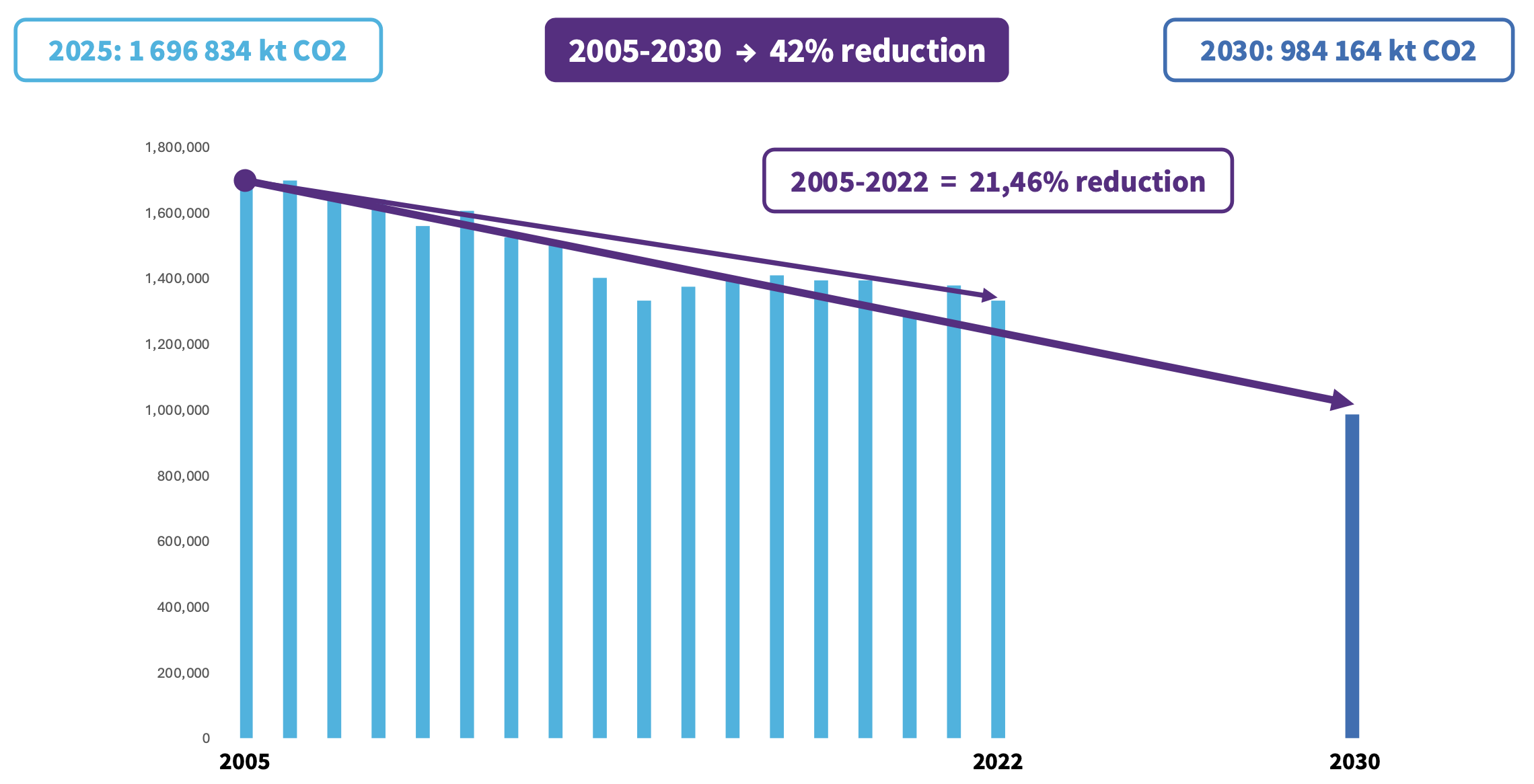
The European Union has committed to an ambitious target of reducing carbon dioxide (CO2) emissions by 55% from the sectors covered under the new Emissions Trading System (ETS2) by 2030, relative to 1990 levels. These sectors include buildings, road transport, energy, and industry. To better understand the practical implications of this goal, it is essential to translate it into more recent historical data.
The earliest reliable emissions data for ETS2 sectors is from 2005. By using 2005 as a reference point, the 55% reduction target from 1990 translates to a 42% reduction in emissions from the 2005 baseline. In 2005, total CO2 emissions from ETS2 sectors amounted to 1,696,834 kilotons (kt) of CO2. Applying a 42% reduction to this value results in a target of 984,164 kt of CO2 emissions by 2030.
However, according to the most recent official dataset from 2022, the total emissions from these sectors stood at 1,332,698 kt of CO2. This represents a reduction of only 21.46% over a span of 17 years (from 2005 to 2022). Given this progress, the EU now faces the challenge of further reducing emissions by 20.54% in the remaining eight years leading up to 2030. This remaining reduction target is almost equal to the progress made since 2005, but it must be achieved in less than half the time.
The implications of this accelerated reduction are significant. It will require a dramatic scaling up of policy measures, technological innovation, and investment in decarbonization strategies across all ETS2 sectors. Meeting this goal is critical for the EU’s broader climate strategy and its commitment to achieving climate neutrality by 2050.
Base Balance & Cap
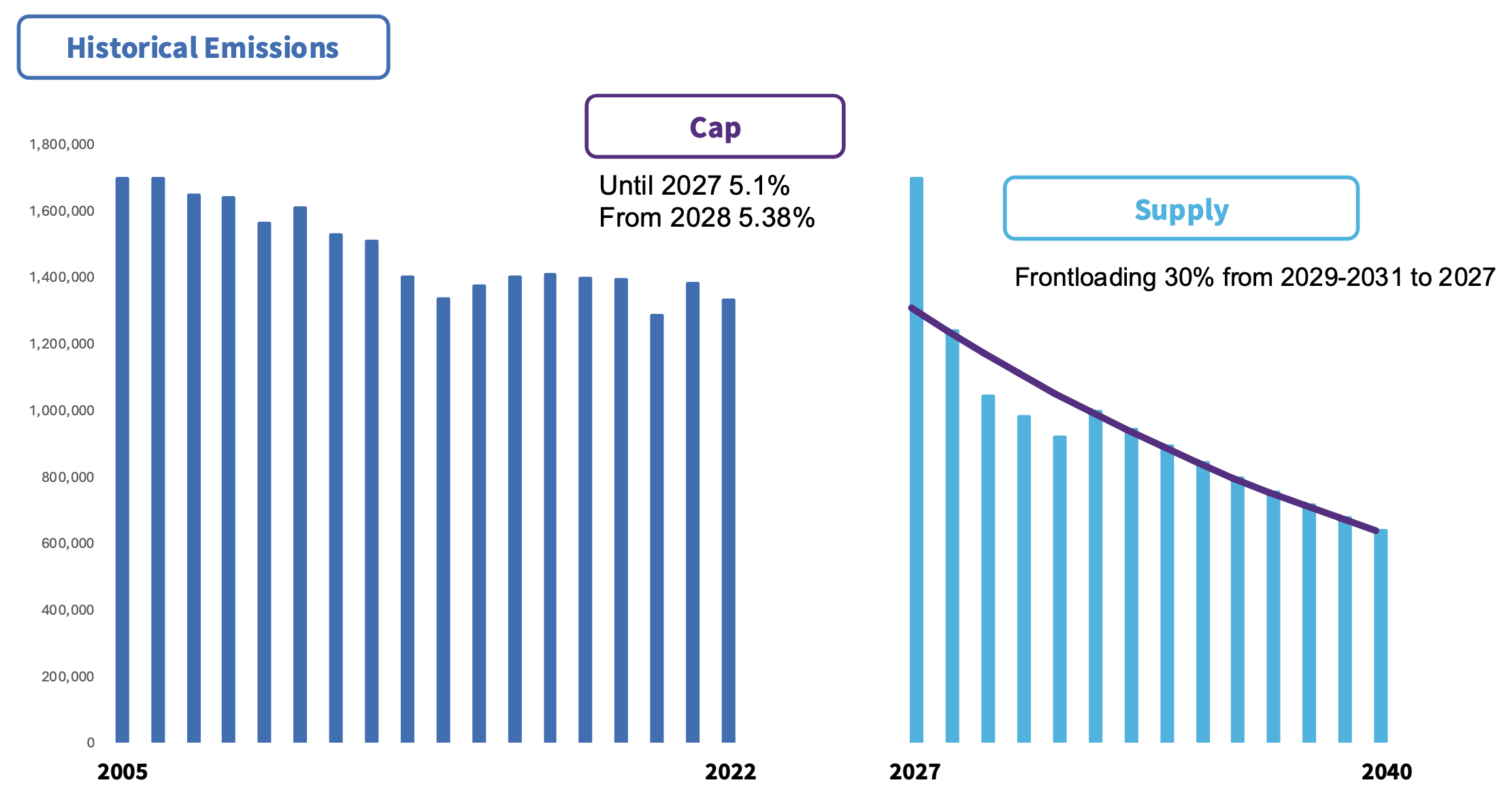
The European Union’s Base Market Balance for ETS2 is set to commence in 2027, or in 2028 if an energy crisis occurs before that time. This balance is derived from the market cap value for 2027, which was publicized by the European Commission in 2024. The starting cap is 1,306,289 kilotons (kt) of CO2, equivalent to 1,306,289,000 EUA2 permits.
This starting value was determined using historical emissions data, incorporating a projection with a Linear Reduction Factor (LRF) of 5.1% applied until the starting year. Beginning with the launch of the ETS2 market, the LRF will increase to 5.38% per year, signaling a more aggressive annual reduction in the cap.
Additionally, as previously explained, in the first year of trading (2027), the market will front-load 30% of the emissions cap from the 2029-2031 period into the 2027 auction volume. This measure aims to provide an initial supply boost to facilitate market stability and liquidity during the early phase of trading.