
The ENCOSE team has been gathering data since the autumn of 2024, holding meetings with Brussels-based stakeholders and various environmental ministries across EU countries to establish a baseline assessment of the demand side in the EU ETS2 system.
Policy Frameworks, Directives, and Key Considerations
This analysis examines the market balance of ETS2 sectors—Road Transport, Buildings, and Energy & Industry—by reviewing historical emissions data and projecting future decarbonization scenarios. By integrating data analysis with policy review, this study aims to assess the evolving dynamics of the carbon market.
The evaluation begins with an assessment of historical emissions. Data for Road Transport and Buildings is sourced from the Intergovernmental Panel on Climate Change (IPCC), providing a broad and reliable foundation. For Energy & Industry, emissions already regulated under ETS1 are excluded using data from the Union Registry of EU ETS stationary installations, provided by the European Environment Agency (EEA). This ensures that only emissions relevant to ETS2 are considered.
Future market scenarios are developed based on key decarbonization drivers for each sector:
- Road Transport: The adoption of electric vehicles (EVs), shifts in fuel market share, and efficiency standards are central factors. Policies such as the Fit for 55 package, the Renewable Energy Directive (RED II and III), and the Energy Taxation Directive play a crucial role in shaping the sector’s trajectory.
- Buildings: Population growth, advancements in energy-efficient technologies, and changing housing trends influence emissions projections. Data from the European Commission Building Stock Observatory and Eurostat provide insights into energy consumption patterns, further shaped by policies such as the Energy Efficiency Directive (EED) and the European Climate Law.
- Energy & Industry: This sector presents more complex challenges, as technological advancements are implemented incrementally. Policies such as the Industrial Emissions Directive (IED), the EU Hydrogen Strategy, and the Carbon Border Adjustment Mechanism (CBAM) significantly influence industrial adaptation to climate goals.
By analyzing historical data and integrating future policy developments and technological advancements, this study provides a comprehensive outlook on how ETS2 sectors are expected to evolve. It identifies the key forces shaping the carbon market and their implications for Europe’s decarbonization efforts.
The application of these directives, policy frameworks, and other influencing factors is incorporated into the baseline demand estimates for EUA2. However, these projections account only for compliance-driven demand from obligated entities and do not include speculative market activity, which plays a significant role in the EU ETS. Additionally, publicly known market mechanisms, such as the Market Stability Reserve (MSR), are factored into the potential market scenarios.
Base values for different scenarios
Energy and Industry
- Absolute Evolution = The absolute average change in emissions from 2005 to 2023.
- Exponential Dynamics = The percentage of average emission changes from 2005 to 2023.
- Accelerated Exponential Dynamics at 2% per year = % average changes + 2%.
Road Transport
- Absolute Evolution = The absolute average change in emissions from 2005 to 2023.
- Exponential Dynamics = The percentage of average emission changes from 2005 to 2023.
- Exponential Dynamics of EVs = The percentage increase in EV sales and their application to emission reductions, based on sales data from 2020 to 2023.
Buildings
- Absolute Evolution = The absolute average change in emissions from 2005 to 2023.
- Exponential Dynamics = The percentage of average emission changes from 2005 to 2023.
- Accelerated Exponential Dynamics at 3.5% per year = % average changes + 3.5%.
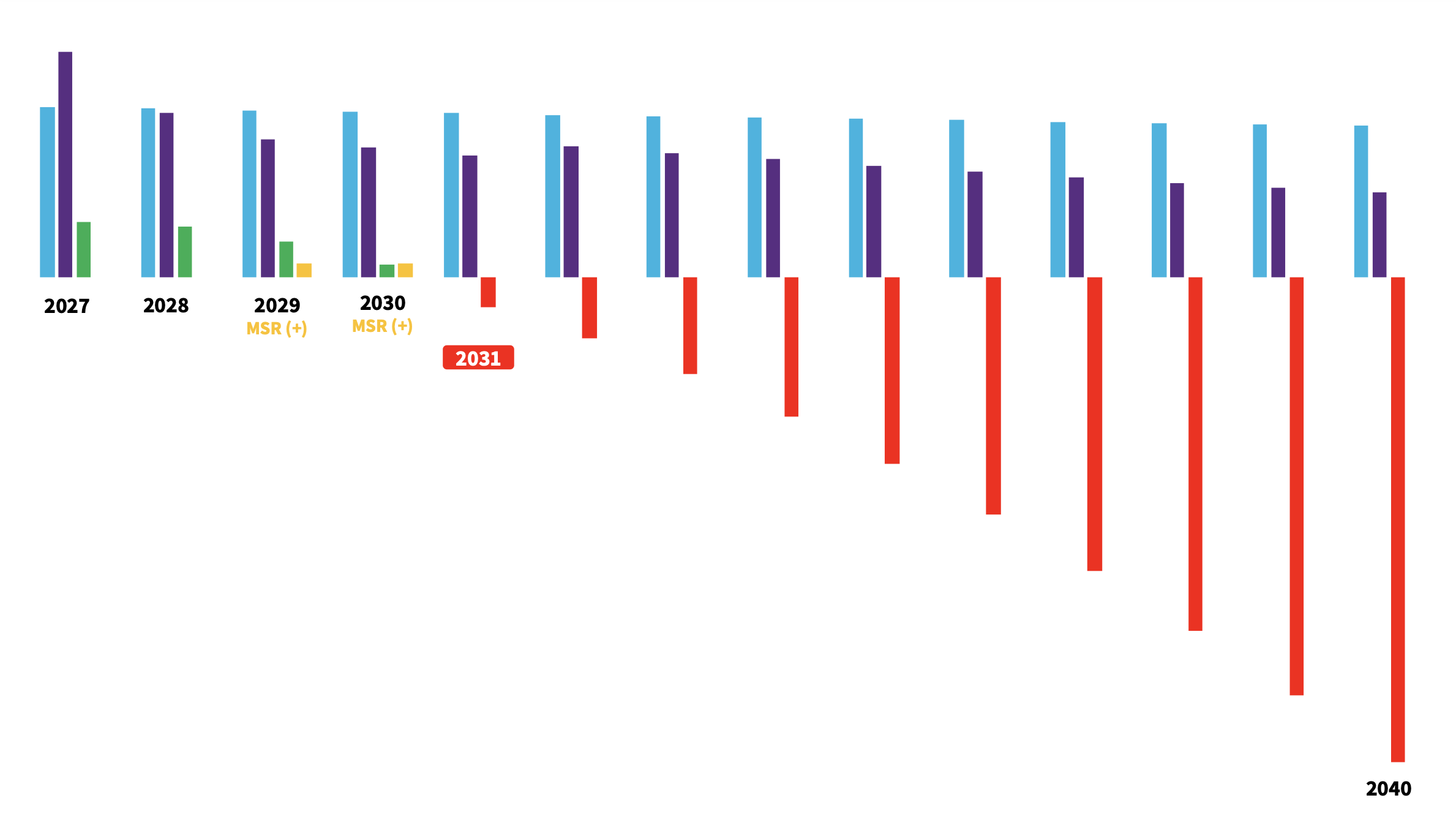
Low Abatement
In our low decarbonization scenario, the MSR is triggered in 2029 and 2030, adding allowances into the market in both years. However, the market becomes short in 2031, with a deficit of 220 million allowances.
Base dataset
- Energy and Industry – Exponential Dynamics (from 2005 to 2023)
- Road Transport – Exponential Dynamics (from 2005 to 2023)
- Buildings – Absolute Evolution (from 2005 to 2022)
Medium Abatement
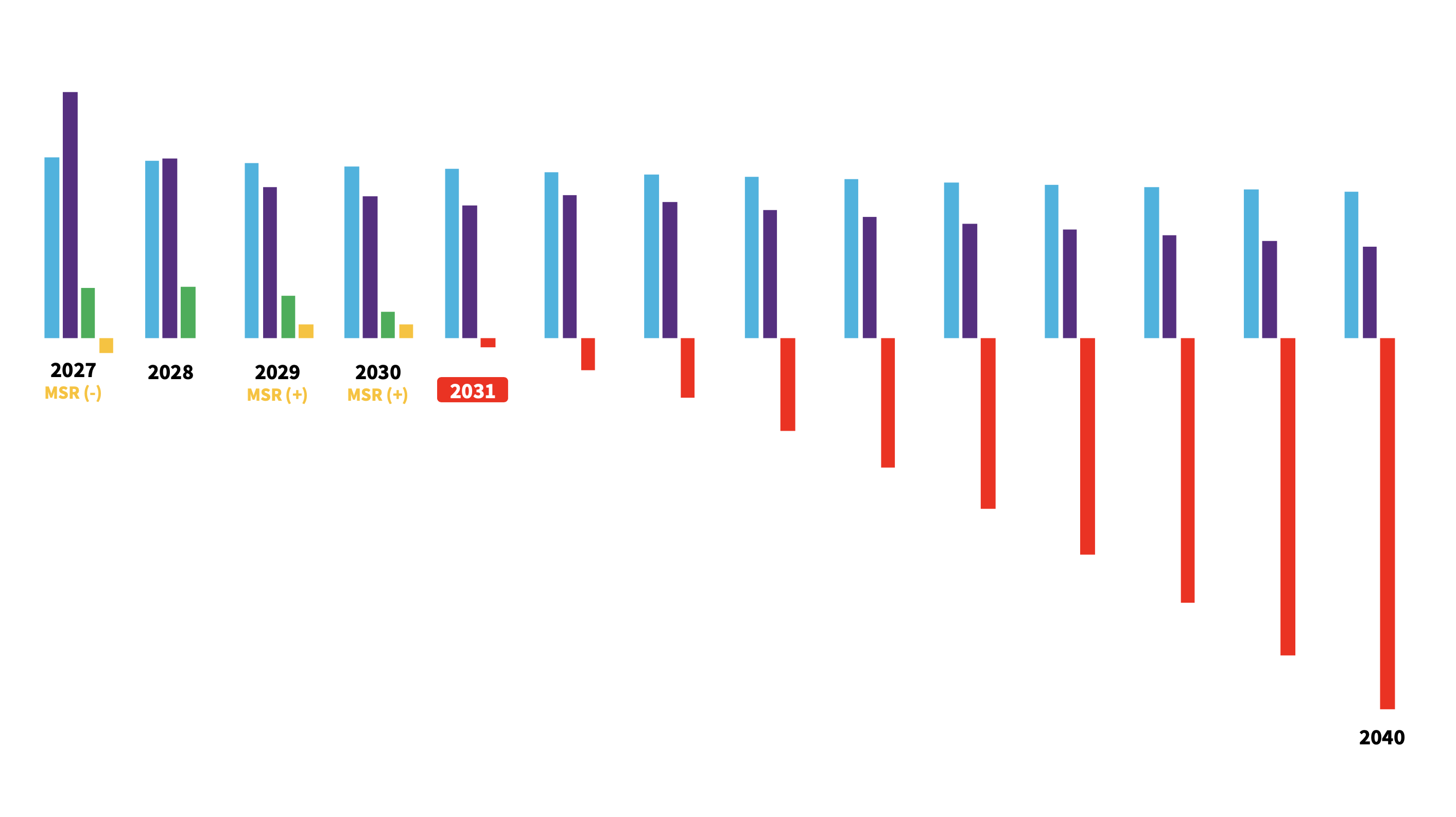
In our medium decarbonization scenario, the MSR is triggered in 2027, withholding allowances, and again in both 2029 and 2030, adding allowances into the market. Similar to the low abatement scenario, the market becomes short in 2031, but with a smaller deficit of 60 million allowances.
Base dataset
- Energy and Industry – Absolute Evolution (from 2005 to 2022)
- Road Transport – Exponential Dynamics of EVs (from 2020 to 2023)
- Buildings – Exponential Dynamics (from 2005 to 2023)
High Abatement
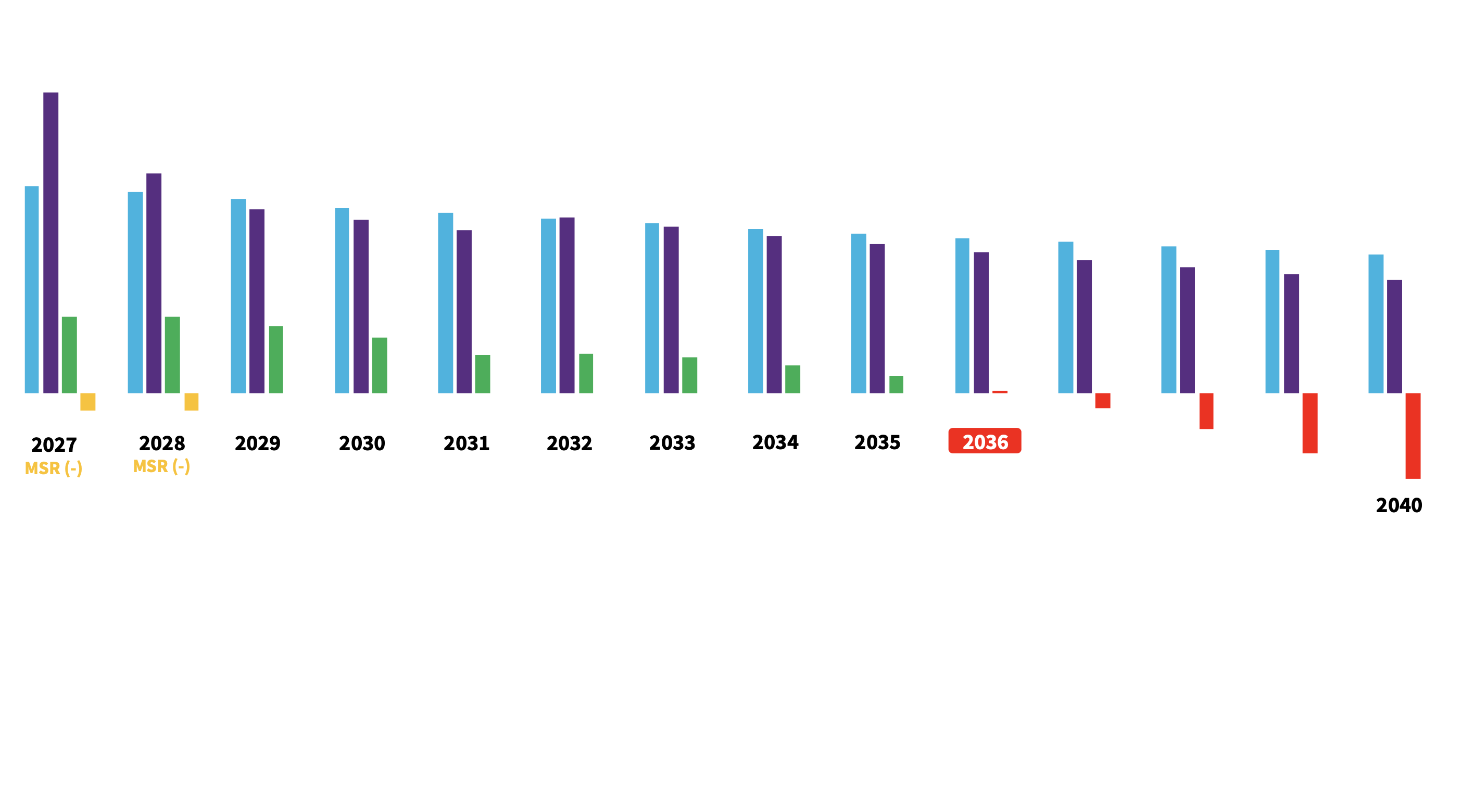
In our high decarbonization scenario, the MSR is triggered in both of the first two years by withholding allowances. This trend continues with moderate decarbonization, roughly aligned with the decrease in allowances in circulation, until 2036, when the market becomes short.
Base dataset
- Energy and Industry – Accelerated Exponential Dynamics at 2% per year
- Road Transport – Absolute Evolution (from 2020 to 2023)
- Buildings – Accelerated Exponential Dynamics at 3.5% per year
This article is intended for informational purposes only and should not be considered financial advice. The projections and scenarios presented are based on historical data and policy frameworks to approximate possible market evolutions. Market conditions may change due to unforeseen economic, regulatory, and technological factors. Readers should conduct their own research and consult with professional advisors before making any investment or trading decisions.