

The European Union is taking a bold step towards carbon neutrality by expanding its emissions trading system to cover previously unregulated sectors. Emissions from buildings and road transport have long been significant contributors to the EU’s greenhouse gas (GHG) footprint, accounting for 12.4% and nearly 19% of total emissions, respectively. Yet, these sectors have remained outside the scope of the EU Emissions Trading System (EU ETS)—until now.
From 2027 (or potentially 2028, depending on energy price conditions), the EU ETS2 will introduce a cap-and-trade mechanism specifically designed for these high-emission sectors. Like the existing EU ETS1, the new system will impose a progressively tightening emissions cap, driving reductions through market-based incentives. The ultimate goal is clear: to curb emissions in line with the EU’s legally binding commitment to achieve carbon neutrality by 2050.
However, the rollout of EU ETS2 comes with market complexities. A dynamic Market Stability Reserve (MSR) will play a critical role in balancing supply and demand, with price thresholds triggering the injection or withholding of allowances. Forecast scenarios indicate that the market could face allowance shortages by 2031, with EUA2 prices varying significantly based on decarbonization efforts. In a low-abatement scenario, prices are projected to surge from €63.04 in 2027 to €204.15 in 2030. Meanwhile, a high-abatement path could moderate price increases, with forecasts suggesting a range from €57.21 in 2027 to €112.61 in 2030.
INTRODUCTION TO REGULATED FUELS
As EU ETS2 reshapes carbon pricing for these key sectors, market participants will need to strategize around compliance costs, investment decisions, and the evolving policy landscape. Understanding the implications of different abatement scenarios will be crucial for both businesses and policymakers navigating this transformative phase in Europe’s climate policy. However, how this market will impact consumer economics?
To truly grasp what will be regulated under the upcoming EU ETS2, we need to look beyond just the sectors—it’s all about the fuels that will fall under the system. So, what’s on the list?
- Natural Gas – A key player in home heating and industrial processes.
- Petrol (Gasoline) – The fuel that keeps millions of cars on the road.
- Gas Oil (Diesel) – A major fuel for trucks, buses, and even some heating systems.
- Coal & Coke – Still used in certain industries and heating systems.
- Heavy Fuel Oil – Common in shipping and industrial applications.
- LPG (Liquefied Petroleum Gas) – Used in heating and some vehicle fleets.
- Kerosene – Found in heating systems and aviation.
Biofuels, such as biodiesel and biokerosene, are also included if they don’t meet the European renewable energy criteria. However, in case they do meet these standards, their emission factor is zero, meaning no emission allowances are required.
EUA2 PRICE REFLECTED INTO FUEL PRICES
Since many countries have slightly different emission values in their National Inventory Reports—such as net calorific value and emission factors—we have selected data from official organizations to provide the most accurate possible results for a general overview of EUA2 future pricing applications. The data sources used are the EEA (European Environment Agency) and the IPCC (Intergovernmental Panel on Climate Change).
The variations in the emission factor, net calorific values, and other fundamental values for fuel CO₂ calculation are not significantly different among the regulated countries (ETS). Generally speaking, the value of a CO₂ emission unit for each of the regulated fuels can be expressed as follows.
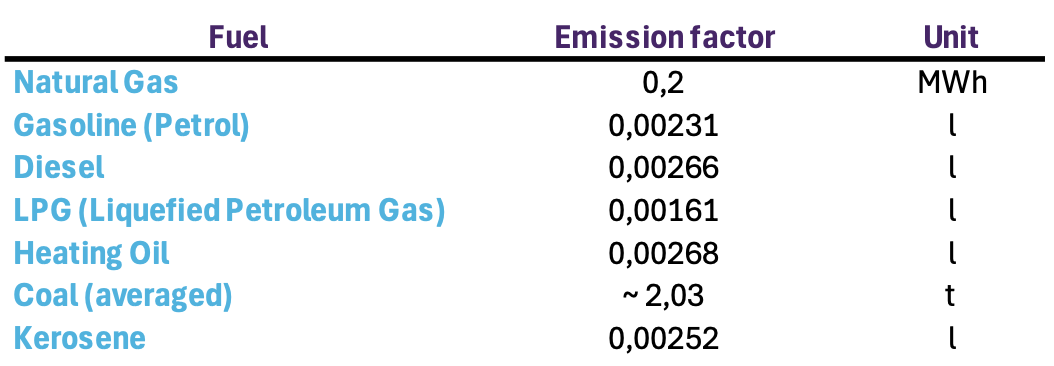
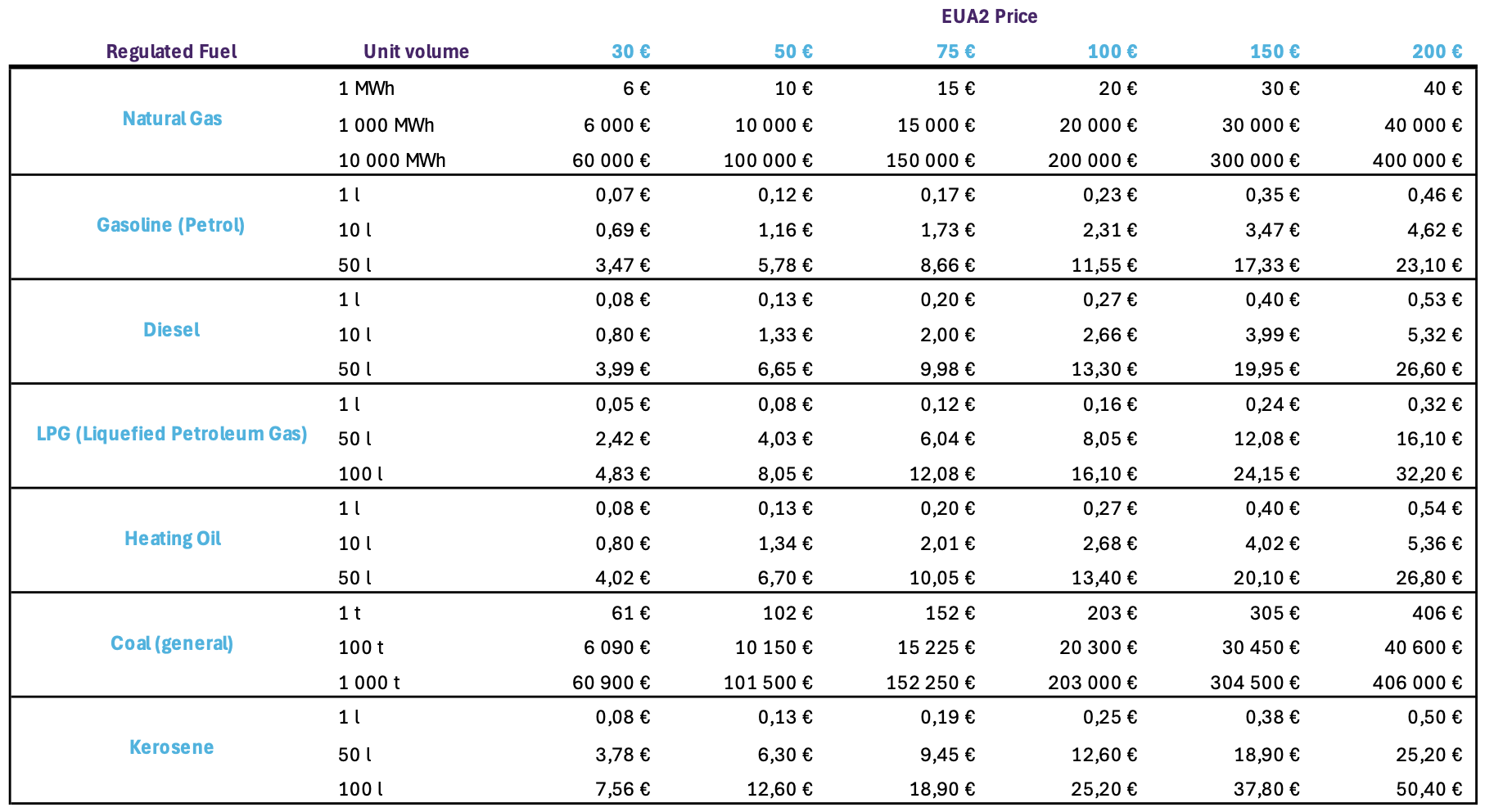
The application of the previously mentioned CO₂ emission values to the regulated fuels is as follows. However, these results cannot be taken literally due to differences in emission factor values across most countries in this future market (explained previously). As a result, the values are very close to reality but should still be considered indicative.
CONCLUSION – DATA INTEGRATION
Once we merge all the data, including the results from ENCOSE studies and the aggregation and averaging of most analytical works on EUA2 price forecasts published to date, we arrive at the following outcome: the application of the likely EUA2 price and its impact on the increase in the price of regulated fuels.
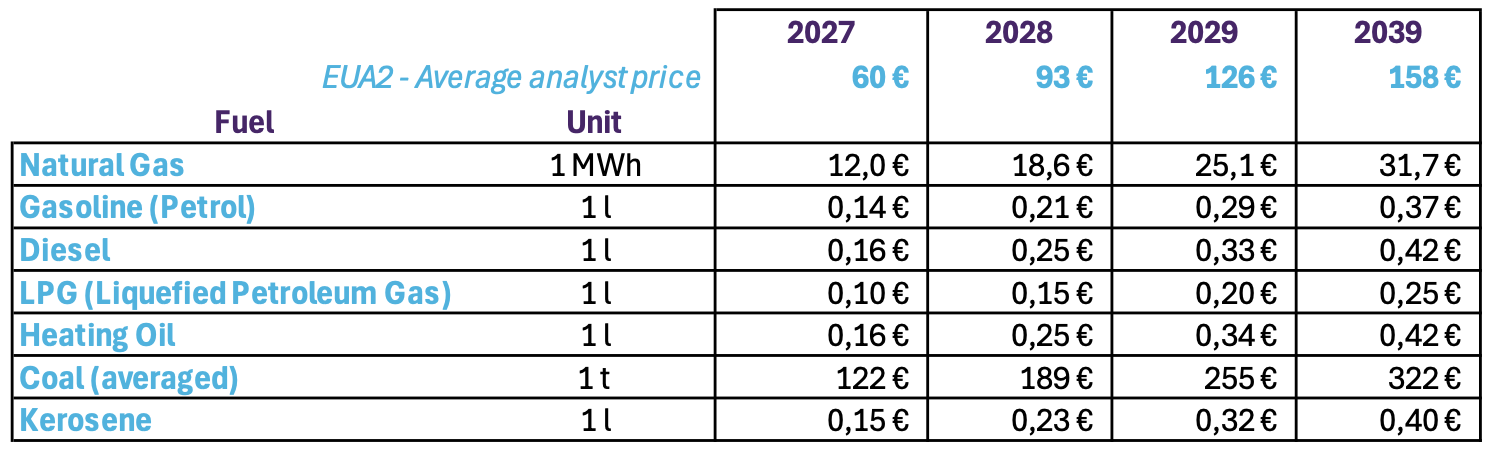
The average price forecast follows a linear trend, ranging from €60.13 in 2027 to €158.38 in 2030. For clarification, these values are purely the result of averaging all analytical price forecasts together.
So, the application of the averaged EUA2 price forecast to the calorific value and emission factor, based on the aforementioned public and official institutions, results in the following values per unit of regulated fuel:
This article is intended for informational purposes only and should not be considered financial advice. The projections and scenarios presented are based on historical data and policy frameworks to approximate possible market evolutions. Market conditions may change due to unforeseen economic, regulatory, and technological factors. Readers should conduct their own research and consult with professional advisors before making any investment or trading decisions.